Audiences in Adobe Real-Time Customer Data Platform: why building the list is the easy part
Audiences in Adobe Real-Time Customer Data Platform: why building the list is the easy part
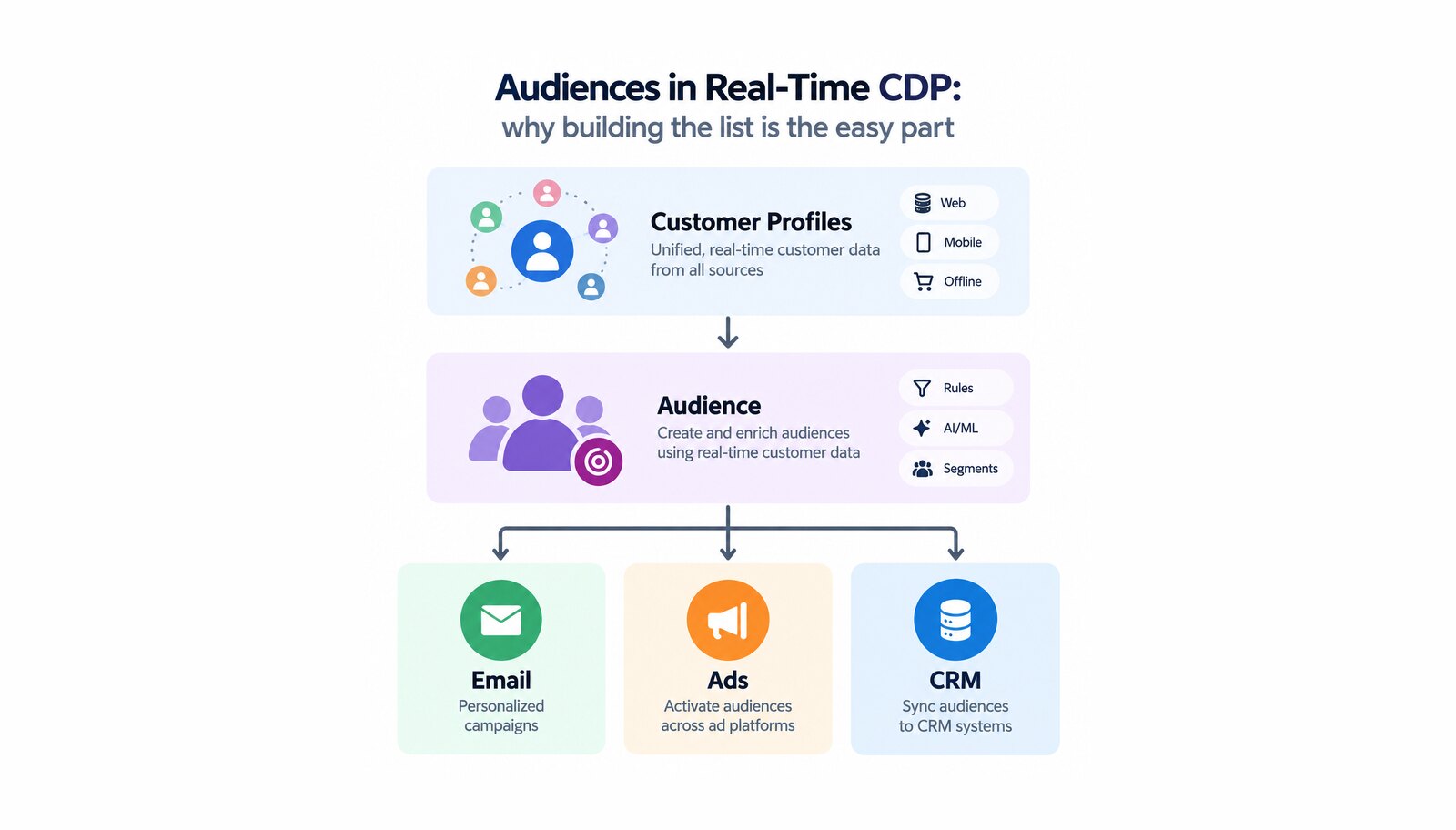
A marketing team asks for something reasonable: everyone who abandoned a cart in the last week, in the advertising platform, by Thursday. Writing that rule takes an afternoon. What decides whether it works is two things nobody asks about — when the platform decides a person qualifies, and what that destination is contractually allowed to be used for.
Adobe Real-Time Customer Data Platform makes both explicit rather than assumed — which is the real argument for building audiences there instead of exporting lists from three systems and reconciling them by hand. It also means both decisions are yours, and one of them is partly irreversible.
Table of contents
- What is an audience in Adobe Real-Time Customer Data Platform?
- Why the evaluation method is the decision that matters
- What a destination is allowed to be used for
- Integration across Adobe Experience Cloud
- What to plan for: permissions, limits and one retirement
- Conclusion: why this is one piece of work
What is an audience in Adobe Real-Time Customer Data Platform?
An audience here is an object, not the output of a tool — a distinction more useful than it sounds. Audience Portal is the central hub within Experience Platform for viewing, managing and creating audiences; its list shows every audience in the organization with its profile count, origin, lifecycle status and evaluation method. Origin is a column, not a category: the values include Segmentation Service, Audience Composition, custom uploads, Audience Manager, Customer Journey Analytics and look-alike audiences.
The commercial consequence is real: an audience uploaded as a file and one built from behavioral rules sit in the same list, activate through the same workflow and answer to the same governance policies. Marketing operations stops being per-channel exports and becomes one auditable inventory.
Two ways to build one. Segment Builder assembles rules from profile attributes, events and existing audiences, and exposes the finished definition as query language for reuse. Audience Composition is the tile-based workspace, and the better fit when the job is combining and splitting audiences that already exist. Both estimate the result before you save — the cheapest way to catch a rule that qualifies either everybody or nobody.
Why the evaluation method is the decision that matters
Three methods, not interchangeable. Batch moves all profile data through the definition at once and runs automatically every 24 hours. Streaming evaluates against incoming data in near real time. Edge evaluates on the Adobe Experience Platform Edge Network, which is what makes same-page and next-page personalization possible.
The part that surprises people: you do not simply pick one. A definition is classified as batch, streaming or edge based on query type and event history duration, and the rule builder shows which methods are eligible and which are not, with the reason attached. You choose among the eligible ones — and that choice has a one-way door: a definition changed from edge or streaming down to batch cannot be changed back.
So the use case has to be settled before the rule is written: "abandoned cart, by Thursday" and "abandoned cart, while they are still on the page" are not the same requirement, and the second constrains how the audience may be defined.
What a destination is allowed to be used for
Three shapes decide how an audience leaves, not whether it may. Streaming Audience Export streams membership to advertising and social platforms, keyed by audience or user ID. Profile Export sends the profile itself, in batch as files of profiles and attributes. Dataset exports are a separate destination type, not a connection: raw datasets to cloud storage.
That is settled in the connection’s governance step, where you declare which marketing actions apply, Export to Third Party among Adobe’s core actions. Get it right and a violating activation is denied, with data lineage explaining why; skip it and the enabled policies have nothing to compare against. See data governance labels and policies.
Integration across Adobe Experience Cloud
An audience is worth building centrally because more than one thing consumes it: the same definition can activate to advertising and email destinations, drive a journey in Adobe Journey Optimizer, and be analyzed alongside behavior in Customer Journey Analytics — instead of three teams maintaining near-identical definitions that drift apart within a quarter.
That consistency depends on the identity layer underneath: audiences resolve against the identity graph, and if one person appears as three profiles the audience is wrong in a way no rule can fix. Groundwork: XDM schemas and Identity Service.
Monitoring closes the loop. Dataflow runs report identities activated, identities excluded and identities failed, hourly for streaming destinations. Excluded is the number worth watching: records skipped for missing attributes or a consent violation rather than failures — nothing turns red while the audience quietly shrinks.
What to plan for: permissions, limits and one retirement
Activation is a four-permission operation, discovered late more often than not: sending data to a destination requires View Destinations, Activate Destinations, View Profiles and View Segments, while connecting one requires View Destinations and Manage Destinations. Different people usually hold those, and a catalog card offering an activate control means a connection exists — not that the viewer may use it.
Streaming destinations need an identity mapped. Where one has target identity namespaces, at least one must be mapped in addition to profile attributes, or the audiences are not activated to the destination platform.
Streaming segmentation only sees streaming data. Data arriving through a batch source is evaluated nightly even when the definition qualifies for streaming, and events timestamped more than 24 hours ago wait for the next batch job. An audience that looks slow is often a source problem, not a segmentation one.
Edge segmentation requires exactly one primary identity, and first calls carry cold-start latency regardless of sandbox type — worth knowing before a first test reads as a failure.
Audience types are not equally supported everywhere. Account audiences work with a short list of destinations, export on a daily schedule only, and support a single evaluation type; prospect audiences to cloud storage support full file exports only. Confirm the combination you need exists before it reaches a plan.
Segment Match should not be designed into anything new. Adobe introduced Real-Time CDP Collaboration in early 2025 as the longer-term approach to exchanging audiences and recommends Prime and Ultimate customers in the United States, Canada, Australia, New Zealand and EMEA move data collaboration use cases to it; elsewhere Segment Match remains the recommendation until Collaboration is released there in 2026.
Conclusion: why this is one piece of work
The mechanics of audience building are a morning of clicking. The value sits in the decisions around them: an identity model that makes the audience mean what it says, an evaluation method chosen for the use case rather than discovered afterward, and destinations that declare what they are for.
Softwhale delivers that chain as one engagement on Adobe Experience Platform and Adobe Real-Time Customer Data Platform — identity and merge policy first, then labels and marketing actions, then audiences eligible for the timing the campaign needs. It is what keeps an audience from being correct in Audience Portal and wrong in the channel.
Unlock the power of Adobe Solution with Softwhale.
Unlock the power of Adobe Solution with Softwhale.
Explore how Softwhale’s expert Adobe solutions can help you build scalable and personalized digital experiences. Dive deeper into insights and best practices tailored specifically to your industry. Stay informed with our latest blog posts on Adobe trends, strategies, and innovations.