Adobe Experience Platform: one customer profile
Adobe Experience Platform: one customer profile
Softwhale plans, builds and operates Adobe Experience Platform (AEP) so that your customer data stops living in disconnected systems and starts driving every message, offer and report your teams produce.







Enhance your customer data foundation
Adobe describes Experience Platform as a system that centralizes and standardizes customer data and content from any source, then applies data science and machine learning to personalized experiences. Everything in it is exposed through RESTful APIs, so the platform is as much an engineering asset as a marketing one.
That openness is why an AEP project is rarely a matter of switching a product on. Someone has to decide how data is modeled in XDM schemas, which identifiers may stitch two records into one person, and which systems become sources and which destinations. Those decisions are hard to reverse once profiles are live — Softwhale settles that layer with you, then implements it.
Why Adobe Experience Platform?
Most enterprises already own the data they need. What they do not own is a single, current, trustworthy version of each customer. Web analytics knows the anonymous session, the CRM knows the account, the loyalty database knows the purchase history, and the email tool knows only an address. Every campaign then starts with a data reconciliation exercise, every report carries a footnote, and every personalization idea waits for an export. Experience Platform exists to remove that layer of guesswork by making the profile, not the channel tool, the center of gravity.

Our Adobe Experience Platform Services
We work across the full lifecycle: the data architecture that comes before the first ingestion, the implementation and integration work, and the operational discipline that keeps profiles, audiences and policies healthy once the platform is in production.
Model & Governance
- Data model and identity design. XDM schemas and field groups, identity namespaces and merge policies, reviewed against your use cases.
- Governance and privacy design. Usage labels, marketing actions and the policies that enforce them.
- Environment and roadmap planning. Sandbox layout and a roadmap to the first activated audience.
Connections & Ingestion
We build the connections, not just the diagrams: ingestion through source connectors from Adobe applications, cloud storage and your CRM; client-side and server-side collection with the Web and Mobile SDKs, sending XDM to the Edge Network; activation into the destinations catalog, including always-on streaming destinations. And native integration with the applications built on the platform — Real-Time CDP, Adobe Journey Optimizer and Customer Journey Analytics.
Applications built on Adobe Experience Platform
Adobe builds several applications on top of Experience Platform, and they share its data foundation, identity graph and governance services rather than maintaining their own. That shared foundation is why the sequence matters: the platform work you do once is reused by every application you add afterwards. The three below are the ones we deliver end to end.
Real-Time CDP brings together known and anonymous data from multiple enterprise sources to create profiles usable across every channel in real time, adding governance, identity management, advanced segmentation and a large ecosystem of partner destinations. Read more about our Real-Time CDP services.
Adobe Journey Optimizer creates and delivers connected, personalized experiences across every channel. Built natively on Experience Platform, it uses the unified profile, an API-first framework and centralized offer decisioning, and lets one team run both scheduled campaigns and real-time, event-triggered communications. See our Adobe Journey Optimizer services.
Customer Journey Analytics brings Analysis Workspace to Experience Platform data, joining any channel — online and offline — into a single reporting view on a common customer ID. It is where the profile foundation turns into cross-channel attribution, flow and fallout analysis. See our Customer Journey Analytics services.
Flow & Segmentation
Once the platform is live, the work changes shape. We monitor source and destination flow runs, tune segmentation so each definition runs under an evaluation method it qualifies for, review merge policies as new identifiers appear, and manage sandbox promotion so a change is proven in development first. Agent Orchestrator adds an agentic layer, which we enable and govern through our Adobe AI services.
Benefits of moving to Adobe Experience Platform
The change your teams feel first is that questions stop turning into projects: audiences are built once in Segmentation Service and are available to any Adobe application.
The commercial case follows: fewer point integrations, one identity graph. In our engagements the platform work opens with a two-week Solution Blueprint and reaches a first production-grade data foundation in 12–16 weeks — the shortening of time-to-value we quote as around 35 %.
Why Choose Softwhale for Adobe Experience Platform?
Experience Platform rewards teams that understand both the data engineering and the marketing use case. We work in that overlap, and we stay after go-live.

What our clients says about us









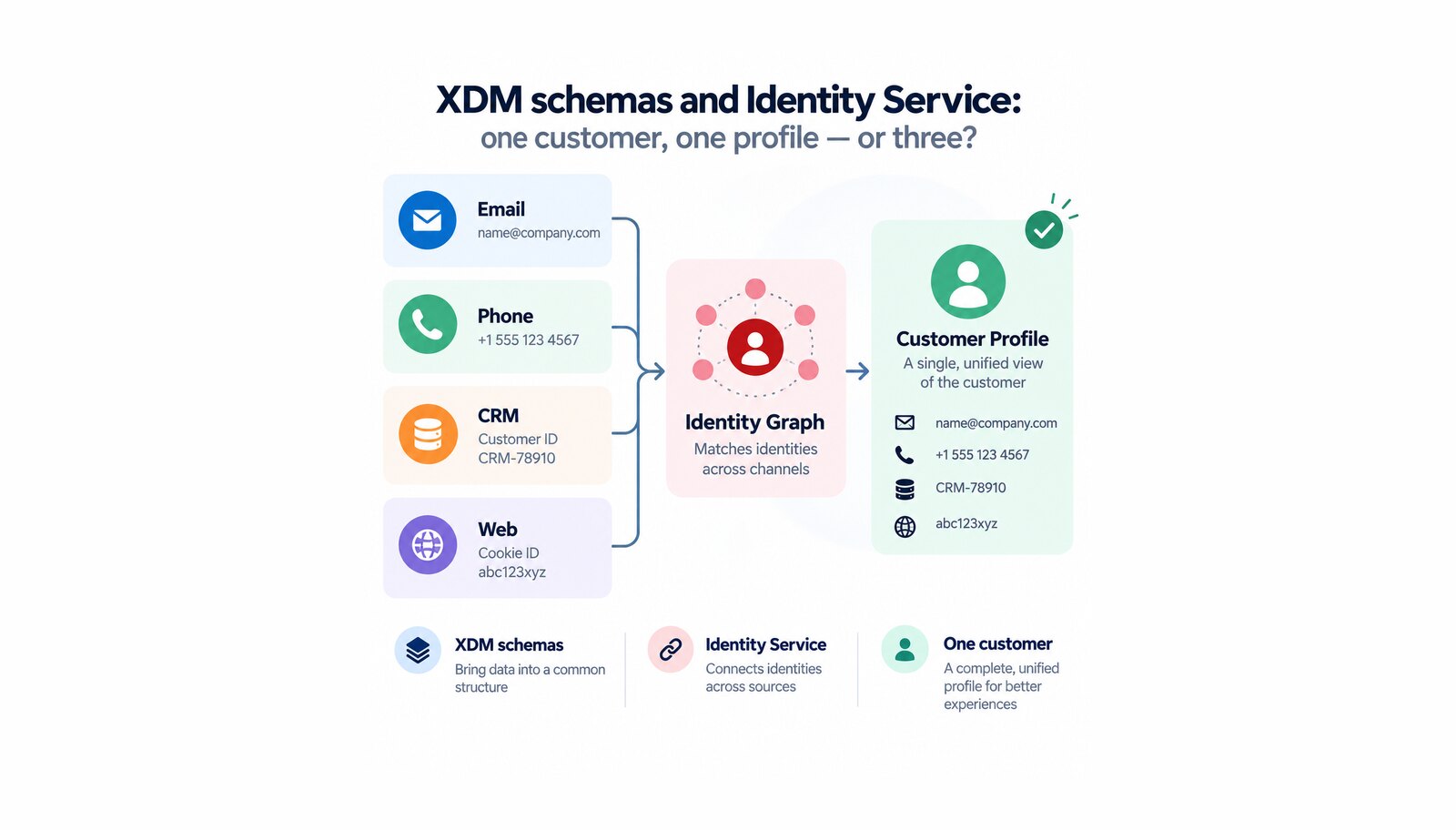
How Adobe Experience Platform decides that three records are one person — what XDM schemas and Identity Service do, and which decisions harden first.

Why one collection layer beats a tag per vendor: what the Adobe Experience Platform Web SDK changes, and what datastreams and tag properties each do.
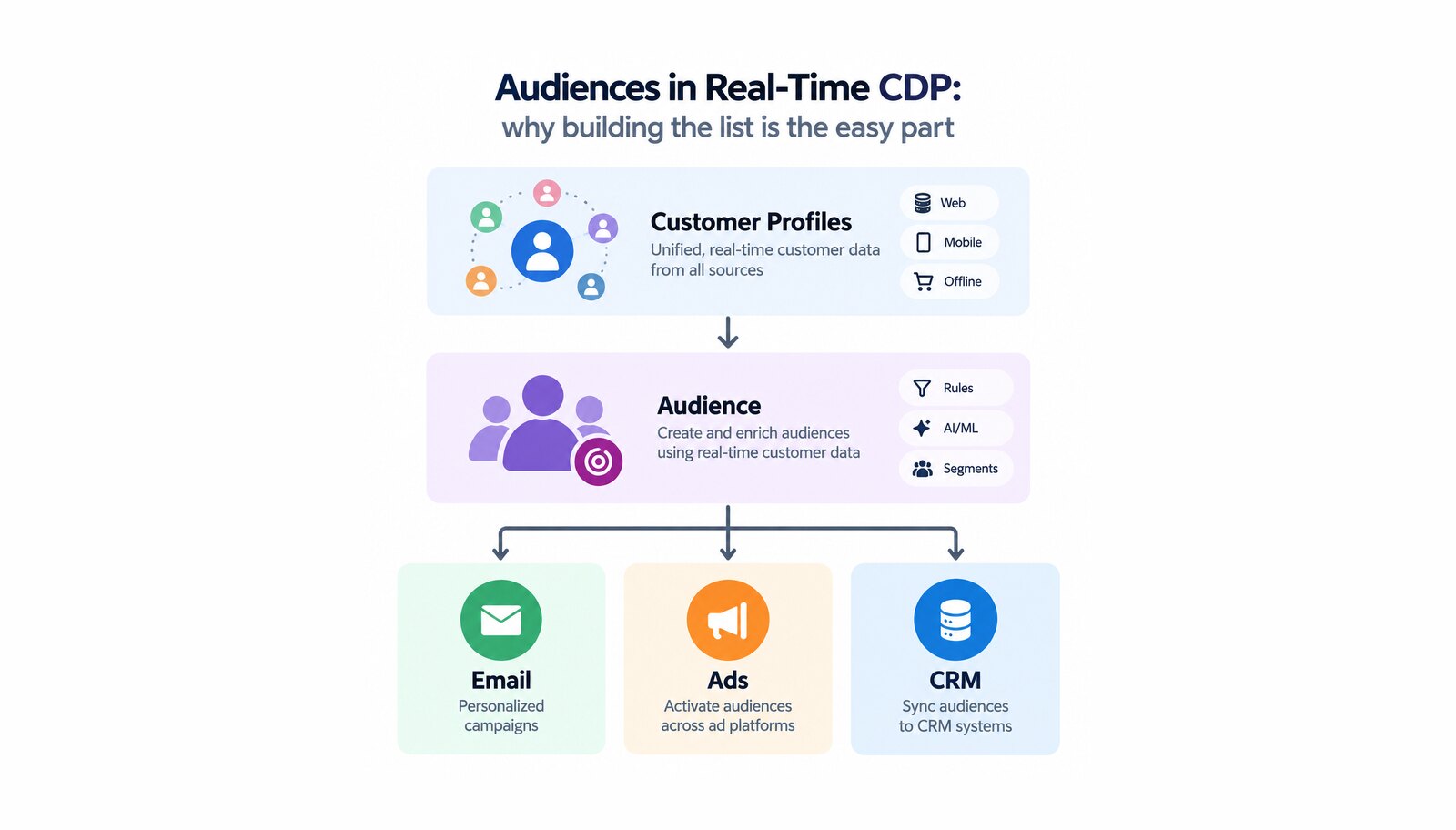
How audiences work in Adobe Real-Time Customer Data Platform: evaluation methods, what a destination may be used for, and the limits to plan around.
FAQ
Is Adobe Experience Platform the same thing as Adobe Real-Time Customer Data Platform?
No. Experience Platform is the foundation; Real-Time CDP is an application built on top of it. Adobe’s own documentation lists Real-Time CDP, Real-Time CDP B2B Edition, Adobe Journey Optimizer, Customer Journey Analytics, Journey Orchestration and Adobe Mix Modeler as applications built on Experience Platform. They share the platform’s profile, identity and governance services rather than duplicating them.
What is a sandbox, and how many do we need?
Sandboxes are virtual partitions within a single Experience Platform instance, and all content and actions taken within a sandbox are confined to that sandbox and do not affect any other. Adobe supports production sandboxes, meant for use with profiles in your production environment and available in multiple instances so you can dedicate them to distinct lines of business, brands, projects or regions, and development sandboxes, used exclusively for development and testing with non-production profiles. The right count follows your organizational and release structure, and we design it during the planning phase.
How does Experience Platform stop us from activating data we are not allowed to use?
Through the Data Governance framework. Data usage labels categorize datasets and fields — identity labels for data that can identify or contact a specific person, sensitive labels for data your organization considers sensitive, and contract labels for contractual restrictions — and a policy is a rule describing which marketing actions are allowed or not allowed on specific data. Applying a label that would violate an existing policy raises a violation dialog in the interface, with a data lineage diagram showing what else has to change first. One caveat worth knowing early: consent policies specifically are available only to organizations that have purchased Adobe Healthcare Shield or Adobe Privacy & Security Shield.
Do we have to replace our current analytics and tag management to start?
Not as a precondition. Adobe Experience Platform Web SDK is a client-side JavaScript library that sends data in a solution-agnostic form (XDM) to the Experience Platform Edge Network, which then maps that data to solution-specific formats and destinations and sends it in real time. It offers a single consolidated SDK for web, mobile and server-side channels and was built to integrate the functionality of several existing libraries, so migration is normally staged rather than simultaneous. Event forwarding, its server-side counterpart, is a paid feature included as part of the Real-Time CDP Connections, Prime or Ultimate offerings.
How quickly can an audience react to customer behavior?
That depends on the evaluation method the audience definition qualifies for. Batch audiences are automatically evaluated every 24 hours, with on-demand evaluation available through a segment job. Streaming segmentation is an ongoing process that updates audiences in response to user activity as data lands in the profile. Edge segmentation is evaluated on the Edge Network and is the method that enables same-page and next-page personalization. Part of implementation is making sure each definition is eligible for the method its use case requires — the interface will tell you when it is not.
Can we use Experience Platform without moving all of our data into it?
Partly. Adobe Federated Audience Composition lets you build audiences from enterprise datasets without copying the underlying data, and store or enrich the resulting audiences in Experience Platform. It is a useful pattern where a data warehouse cannot be duplicated for legal or practical reasons, though it does not replace ingestion for use cases that need event-level data on the profile itself.
What does a first engagement with Softwhale look like?
A short discovery on your use cases, source systems and constraints, followed by a data model and identity proposal, a governance outline, and a sequenced implementation plan you can approve step by step. That first stage is the two-week Solution Blueprint: fixed scope, fixed price, quoted after the discovery call rather than from a price list.
Ready to get more out of Adobe Experience Platform?
Ready to get more out of Adobe Experience Platform?
Tell us what you need working and we will scope the next step with you — a discovery, an implementation plan, or a second opinion on what you already have.