Adobe Marketo Engage: turning a lead score into a funnel you can measure
Adobe Marketo Engage: turning a lead score into a funnel you can measure
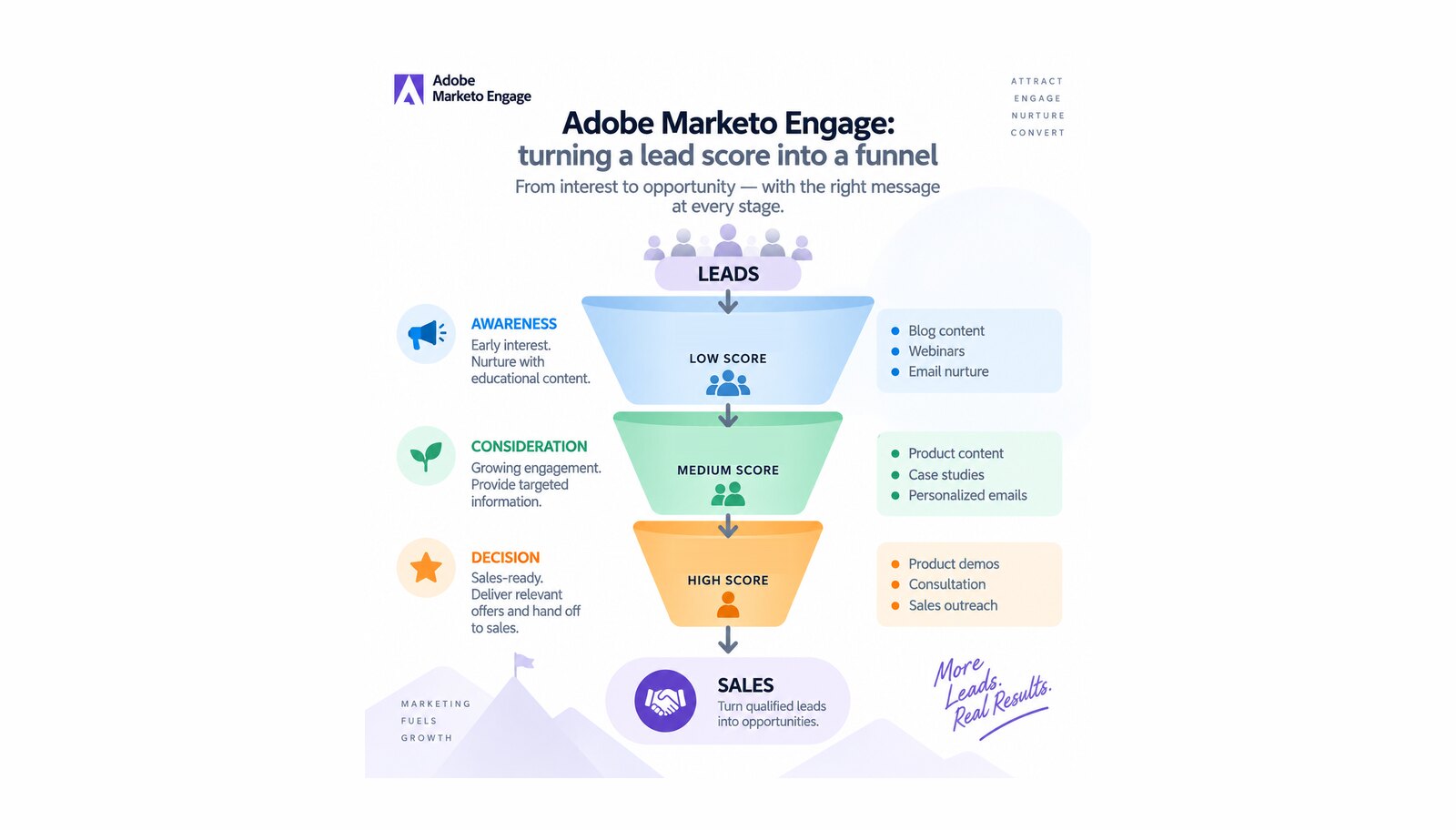
Every B2B marketing team eventually has the same argument with sales. Marketing says the leads are good; sales says they are not; nobody can prove it, because "good" was never written down as something a system could evaluate.
Adobe Marketo Engage answers that with two connected pieces. Lead scoring turns what a lead does and who a lead is into a number both teams sign off on. The revenue cycle model turns that number into measurable movement through a funnel. A score with nowhere to go is a vanity metric; a funnel model with no scoring rule behind it is a slide.
Table of contents
- What is lead scoring in Adobe Marketo Engage?
- Why one score is never enough
- Scoring in practice: what actually moves the number
- The revenue cycle model: a funnel with stages you can measure
- Integration across Adobe Experience Cloud
- What to plan for: editions, add-ons and one irreversible step
- Conclusion: why scoring and the lifecycle model belong together
What is lead scoring in Adobe Marketo Engage?
Adobe defines a scoring model as "a framework that assigns point values to person records based on demographic attributes and behavioral actions to determine lead quality and sales-readiness." Two phrases carry the design: lead quality and sales-readiness are separate questions, answered by separate evidence — attributes on one side, actions on the other.
Marketo Engage is built for that separation, supporting behavior and demographic scores as distinct values that can then be combined into a composite. Scores are moved by scoring campaigns, through a flow action that adds points, subtracts them, or sets an exact value. Adobe also ships operational programs for both kinds of scoring in its program library, imported rather than rebuilt, with the scoring values held in tokens.
Why one score is never enough
Adobe’s checklist for a new instance is direct: break out both behavior and demographic scores from the general score.
The reason follows from the definition. A downloaded white paper and a job title both add points, but one says a lead is engaging with you now and the other says a lead matches who you sell to. Blend them and an engaged student lands on the same total as a disengaged buying-committee member, with no report able to separate them afterwards. Two scores make the conversation answerable: when sales rejects a batch, was it qualified but cold, or interested but wrong-fit? Only one of those is a scoring problem.
Scoring in practice: what actually moves the number
Scoring fields are ordinary custom fields, so you can keep as many as your model needs, and each is moved only by the campaigns you point at it. That is what makes a model auditable: every point on a record got there through a rule somebody wrote and can still read.
Scoring becomes routing at the threshold. A transition rule can require a score of at least a given value before a lead moves on — Adobe’s worked example moves leads scoring at least 40 into a stage named Sales Lead. Set that number with sales present: it defines hand-off, not a display preference.
The revenue cycle model: a funnel with stages you can measure
Revenue cycle models "model all the stages of your entire revenue funnel", in Adobe’s words, from first interaction to won customer. A new model starts with six revenue stages on the green background Adobe calls the Success Path. Stages are the milestones; transitions are the arrows controlling movement between them, and Adobe recommends transitions always include triggers so reporting reflects genuine velocity.
Adobe’s mental model is a row of buckets with holes in the bottom: what flows in, what flows out, and how much sits in each bucket now — the stage balance. A bottleneck is a balance that grows while outflow does not. One stage is fixed rather than designed: the anonymous stage holds website visitors you cannot yet identify, and Adobe states plainly that you cannot modify it. Three stage types exist, separated by what each does to time and to flow.
- Inventory stages. "All known leads and accounts initially reside in the Inventory Stage," Adobe writes, and "there is no time limit on an inventory stage." This is the nurture pool, where a lead can legitimately sit for a year.
- SLA stages. SLA stands for service level agreement, used "when there is a defined maximum time in which a lead needs to be evaluated or processed". An SLA stage is a clock: it makes a response-time promise measurable.
- Gate stages. A gate stage "serves as a qualification check", and its most valuable property is one most people assume backwards. A gate splits leads based on criteria you enter in the transition rules; it does not hold leads, and a default transition is required so anything the other rules miss still goes somewhere. A gate is a fork, not a waiting room; without a default it is where leads quietly disappear.
Integration across Adobe Experience Cloud
Scoring in Marketo Engage is a policy you author. Predictive scoring on Adobe Experience Platform is a different mechanism in a different product: Customer AI generates "customer predictions at the individual level with explanations", and does it "without having to transform the business needs to a machine learning problem, pick an algorithm, train, or deploy." One produces a number you can defend line by line; the other produces a likelihood plus the factors behind it. Treating them as two versions of the same thing is the expensive mistake, so we scope the predictive side on our Customer AI and Attribution AI page and demand generation on our Adobe Marketo Engage page. Which programs deserve credit for a closed deal is a third question, owned by Adobe Marketo Measure.
What to plan for: editions, add-ons and one irreversible step
Availability is the first thing to establish, because it is most likely to be assumed. Adobe attaches "Not all Marketo editions include this functionality" directly to Revenue Cycle Analytics reporting; its reporting overview places Revenue Cycle Models inside the Advanced Journey Analytics product, while Advanced BI Analytics — formerly Revenue Cycle Explorer and Advanced Report Builder — needs a purchased add-on. Adobe’s summary: "Not everyone has purchased Advanced BI Analytics and Advanced Journey Analytics modules."
Three further constraints shape how a model is run:
- One approved model at a time. "You may only have one approved model at any given time" makes the funnel model a shared asset, not a per-team variant.
- Unapproving is destructive. "If you unapprove your model all of your people are removed from the model, and their history in the model is deleted!"
- Reporting has entry conditions. Leads must be members of a model to appear in its report, and the model must be approved, or at least have approved stages.
Conclusion: why scoring and the lifecycle model belong together
A score is a judgment about one lead; a revenue cycle model is a judgment about the shape of your demand. Marketo Engage gives you both, and lets one drive the other.
The hard part was never the configuration. It is agreeing what a qualified lead means, choosing stage types that match how you sell, and writing down thresholds you will be held to. That is the work we do first on an Adobe Marketo Engage engagement.
Unlock the power of Adobe Solution with Softwhale.
Unlock the power of Adobe Solution with Softwhale.
Explore how Softwhale’s expert Adobe solutions can help you build scalable and personalized digital experiences. Dive deeper into insights and best practices tailored specifically to your industry. Stay informed with our latest blog posts on Adobe trends, strategies, and innovations.